A Quick Read of OTW's 2024 Annual Report: What Happened With AO3, Fanlore, and Open Doors
If you think of OTW only as “the organization behind AO3,” its annual report may be more complicated than expected. It does include AO3 numbers, page views, tickets, and technical updates. But it also covers Fanlore, Open Doors, legal advocacy, volunteer recruitment, financial statements, and organizational governance.
As of June 7, 2026, the latest Annual Report listed on OTW’s official Reports & Governing Documents page is still the 2024 report.1 So the latest complete report available to read in full is the 2024 Annual Report.
Start with the numbers
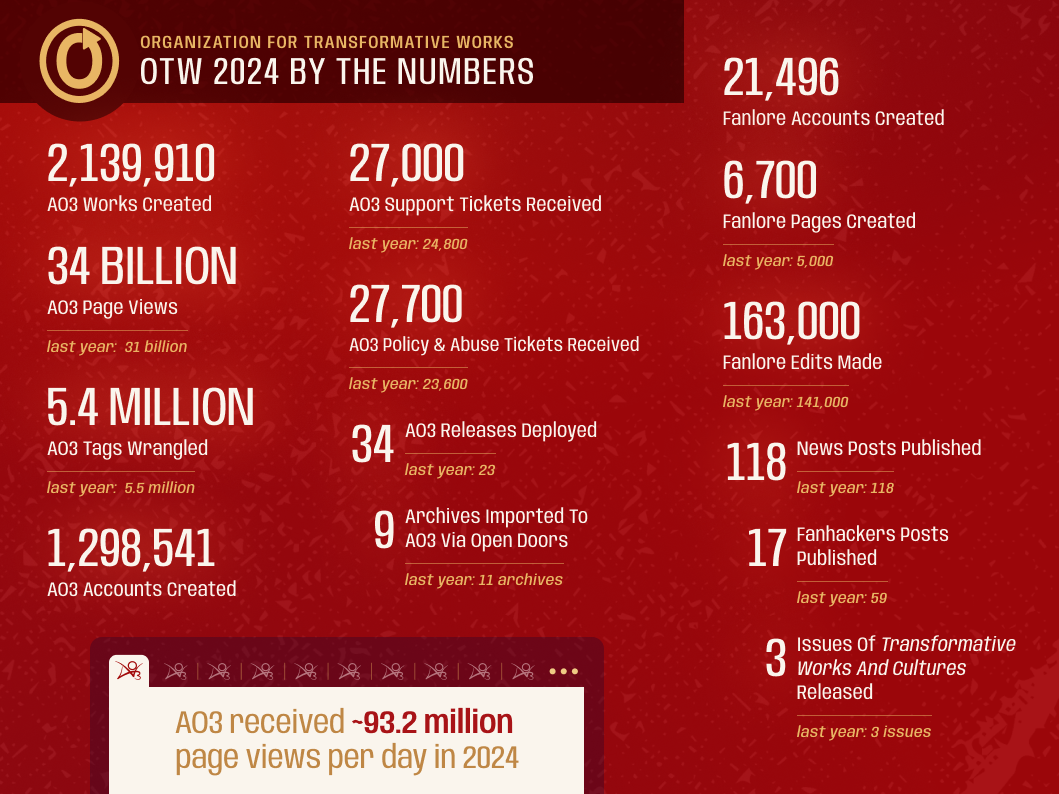
Image source: OTW 2024 Annual Report, “2024 by the Numbers.” 2
The image is translated from OTW’s official “2024 by the Numbers” infographic. The most obvious takeaway is that AO3 is still growing, and so are the everyday maintenance pressures around Support and Policy & Abuse. At the same time, projects that ordinary AO3 users may not see as often, such as Fanlore and Open Doors, are still preserving the scattered pieces of fan culture.
AO3: 15 years, 14 million works, and 34 billion page views
In 2024, AO3 turned 15, and the archive reached 14 million fanworks. The annual report’s numbers graphic also lists 2,139,910 AO3 works created in 2024, 1,298,541 AO3 accounts created, 34 billion page views, and an average of about 93.2 million page views per day.32
These numbers do show that AO3 is large. But they also point to something else: AO3 is a large archive system that needs long-term maintenance, constant scaling, and ongoing handling of abuse reports and misunderstandings about rules.
TOS update: not changing what AO3 allows, but making the rules clearer
In 2024, AO3 completed its long-awaited Terms of Service update. The report notes that the update clarified the language around content policy, privacy policy, and abuse policy, and made those policies easier to read and use. It did not change what kinds of works AO3 allows on the site.3
One change users were likely to notice was that one Archive Warning was renamed to make its scope clearer. This was not an expansion or restriction of the rules. It was meant to reduce long-running confusion in reports and rule interpretation.
The TOS FAQ also received a major update: nearly 20,000 new words and more than 130 new questions. During the open comment period, the related posts received more than 4,300 user comments, and the Policy & Abuse and News Post Moderation teams replied to more than 400 of them.3
These numbers are a reminder that AO3’s rules are not written only for lawyers. The wording shapes how ordinary users understand warnings, reports, privacy, abuse, and the boundaries of the platform.
Ticket numbers: AO3 is heavily used, and people keep asking for help and filing reports
In 2024, Policy & Abuse received 27,700 tickets, up from 23,600 in 2023. Support received 27,000 tickets, up from 24,800 in 2023. Support even reached a new monthly high in September, with 4,150 tickets, more than twice its usual level of around 2,000 per month.3
These numbers matter to ordinary readers too. When you run into a tag issue, a technical problem, a work management question, or a reporting issue, the people handling it are not a customer service company. They are OTW volunteer teams and committees.
Technical updates: 34 releases, and tags are still heavy work
AO3’s Accessibility, Design, & Technology team deployed 34 releases in 2024, up from 23 in 2023. Updates included preventing blocked users from sending unsolicited gifts, restricting images in places such as news comments, upgrading to Rails 7.0, and several anti-spam-comment changes.32
Tag Wrangling wrangled 5.4 million tags in 2024 and canonized 6,050 new fandoms. The number of tags wrangled was slightly lower than 2023’s 5.5 million, but it is still a huge volume.3
To users, the tag system looks like search and filtering. For AO3, it is more like a semantic system that has to be maintained over time. Synonyms, character names, ship names, fandom names, multilingual tags, and all kinds of messy usage patterns need people to keep working on them.
Open Doors: old archives do not survive automatically
Open Doors continued preserving old archives in 2024. The main report says that Open Doors completed 10 imports. As of December 31, 2024, Open Doors had migrated 164,016 digital fanworks from 111 archives.4
The numbers graphic, however, summarizes this as “9 archives imported to AO3 via Open Doors.” That wording is not exactly the same as the main project section’s “10 imports.” It may have to do with the difference between archives imported to AO3 and the wider Open Doors project statistics. When the summary graphic and the text use slightly different figures, it is better to return to the project section for context.
For ordinary AO3 users, the value of Open Doors is this: works from old sites, old archives, and old fandom spaces do not automatically survive. Someone has to contact maintainers, organize materials, handle imports, and sort out permissions before those works can move to a more stable place.
Fanlore: preserving not only works, but memory
Fanlore was active in 2024 as well. The numbers graphic lists 21,496 Fanlore accounts created, about 6,700 pages created, and 163,000 edits made. The Fanlore project section also says that by the end of 2024, Fanlore had 72,936 total pages and 1,531,996 total edits.52
If AO3 preserves works, Fanlore preserves something closer to the context around those works: terms, events, community memory, old platforms, fan activities, and different points of view. AO3 users may not open it every day, but like Open Doors, it is another part of OTW’s work to preserve fan culture.
That is also why small entries, little archival notes, and fandom terms from Chinese-language fandom are worth writing down. They may not feel “newsworthy,” but years later, people may rely on those pages to understand a piece of fandom history.
Legal Advocacy: OTW does more than maintain AO3 servers
In 2024, OTW’s Legal Advocacy handled many issues related to fan freedom, including children’s online safety bills, age verification, restrictions on social platforms, AI and likeness-related laws, and the effect of mistaken copyright takedowns on access to AO3 search results. The report also notes that they dealt with several apps and websites infringing OTW and AO3 trademarks, and investigated and handled an app that charged for access to AO3 works.6
This part may be less immediately visible to ordinary users than the work count. But it explains why OTW is not an organization that only handles AO3 technology. For AO3 to remain noncommercial, open, and protective of creative space, it needs legal advocacy, policy responses, and public explanations.
Organizational culture and volunteers: the least “technical” part of the 2024 report
The opening of the 2024 report spends a lot of time on organizational culture. The Board says that OTW worked with an external culture firm on a months-long organizational culture audit, interviewed volunteers across levels and committees, and began developing an Organizational Culture Roadmap. The roadmap focuses on six areas: accountability, safe and welcoming internal chat spaces, global accessibility and cross-cultural sensitivity, open and transparent collaboration, organization-wide management standards, and volunteer safety and security.7
This may seem far away from AO3 users, but it is hard to separate from AO3’s long-term future. AO3, Fanlore, Open Doors, Legal Advocacy, and TWC all depend on volunteers. A large fannish infrastructure cannot run long-term only on the fact that people care. It also needs clear processes, safer spaces for collaboration, and more stable ways to manage work.
The report also says that OTW received 1,398 volunteer applications in 2024, accepted 385 volunteers, removed 382 volunteers, and had 889 volunteers at the end of the year.8
Finances and donations: money goes into infrastructure
In 2024, Development & Membership held two major membership drives. The April drive raised USD 207,088.91 from 6,073 donors in 70 countries. The October drive raised USD 214,698.86 from 6,955 donors in 86 countries.9
This section is best read together with the numbers above. Works, page views, tickets, tags, imports, Fanlore edits, legal advocacy, and volunteer management are not things that “just happen” because a website exists. They need servers, tools, volunteer time, legal support, and organizational operations.
So when OTW says it is a fan-run, donor-supported nonprofit, that is not an empty line. The numbers in the annual report make it concrete: user donations and volunteer labor support specific parts of the system.
What does this report tell ordinary AO3 users?
AO3 is still growing. Works, accounts, page views, and tickets are all increasing, and AO3 is already a large archive that needs long-term governance.
OTW’s work is not only AO3. Fanlore, Open Doors, TWC, and Legal Advocacy each do different things: preserving works, preserving memory, preserving space for research, and maintaining the legal boundaries that protect creative freedom.
The volunteer organization itself also needs maintenance. The 2024 organizational culture audit, roadmap, new committee, and new subcommittees show that OTW is dealing with internal collaboration, multilingual support, and safety issues. These things are less visible than “how many works were added,” but they affect whether the whole system can keep running.
Taken together, these numbers make OTW’s everyday work more concrete. If you care about how fanworks and fandom memory are preserved, and why this kind of creative space can continue to exist, the report makes it clearer what OTW is doing for that.
OTW’s official Reports & Governing Documents page lists Annual Reports from 2007 through 2024. As of June 7, 2026, the list does not include a 2025 Annual Report. https://www.transformativeworks.org/reports_docs/ ↩︎
OTW’s 2024 Annual Report, “OTW 2024 by the Numbers” infographic, lists annual numbers for AO3, Fanlore, Open Doors, news posts, and TWC. https://www.transformativeworks.org/reports_docs/2024-annual-report/ ↩︎ ↩︎ ↩︎ ↩︎
OTW’s 2024 Annual Report, Archive of Our Own section, records AO3’s 15th anniversary, 14 million works, TOS update, Support and Policy & Abuse tickets, technical releases, and tag wrangling work. https://www.transformativeworks.org/reports_docs/2024-annual-report/ ↩︎ ↩︎ ↩︎ ↩︎ ↩︎ ↩︎
OTW’s 2024 Annual Report, Open Doors section, records the imports completed in 2024 and the total number of digital fanworks migrated by the end of 2024. https://www.transformativeworks.org/reports_docs/2024-annual-report/ ↩︎
OTW’s 2024 Annual Report, Fanlore section, records pages created, edits made, accounts created, and the MediaWiki upgrade in 2024. https://www.transformativeworks.org/reports_docs/2024-annual-report/ ↩︎
OTW’s 2024 Annual Report, Legal Advocacy section, records legal advocacy, legislative responses, trademark issues, and mistaken copyright takedowns in 2024. https://www.transformativeworks.org/reports_docs/2024-annual-report/ ↩︎
OTW’s 2024 Annual Report, Letter from the Board of Directors, explains that OTW conducted an organizational culture audit in 2024 and began developing the Organizational Culture Roadmap. https://www.transformativeworks.org/reports_docs/2024-annual-report/ ↩︎
OTW’s 2024 Annual Report, People & Planning section, records 2024 public meetings, the organizational culture audit, volunteer applications, accepted volunteers, removed volunteers, and year-end volunteer count. https://www.transformativeworks.org/reports_docs/2024-annual-report/ ↩︎
OTW’s 2024 Annual Report, Fundraising & Outreach section, records the donation amounts, donor counts, and countries involved in the April and October 2024 membership drives. https://www.transformativeworks.org/reports_docs/2024-annual-report/ ↩︎